“The drums of war have returned to our doorsteps once again. The sounds of sirens, missile explosions, panicking neighbors, and children crying ring louder and longer. We have been here before… Our skin is thicker now, and our nerves are adapting with each passing day. Yet something about this moment feels darker than anything that came before,” wrote Musalaha’s Executive Director Daniel Munayer at the end of March, amid the region’s rising hostilities.
That context of hostility isn’t exactly new for Musalaha, which works in both Israel and Palestine. They’ve been operating in such a context for some time. But, as Munayer reflects, somehow this time feels darker than anything that has come before.
But rather than a reason to slow down, to be discouraged – or even stop – for Musalaha the darkness of this moment provides even more reason to persevere and continue on. Because the Light came into the darkness.
Founded in 1990, Musalaha (which means “reconciliation” in Arabic) is a faith-based organization that teaches, trains, and facilitates reconciliation among individuals from diverse ethnic, religious, and social backgrounds. Their focus is often reconciliation among Israelis and Palestinians.
On the surface, it sounds simple. But in a context marked by war, true reconciliation is anything but simple. Because the work of reconciliation begins with imagination. Imagination that the present reality, a reality marked by hostility and divisiveness, isn’t the only possibility. Imagination that two not just different, but opposing, groups could come together to create a new identity.
But for many that is something of a pipe dream, a reality so different from their lived experience that they cannot even imagine it.
For some, violence and hostility are all they’ve known. It’s all around them - checkpoints, military, air raid sirens. Surrounded by such constant reminders of hostility, it is easy to lose one’s imagination for a different future.
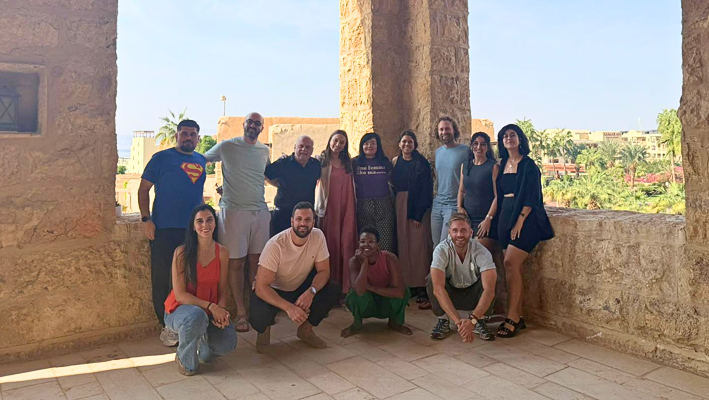
Musalaha invites that imagination to return. It invites participants to imagine a future marked not by another war, not by violence, but by reconciliation and by peace. Such a future begins with the participants, with a small group of maybe 20 people, evenly split between groups coming together to learn and work together. By bringing people of diverse ethnic, religious, and social backgrounds together in relationship, Musalaha aims to create a new identity. Rather than us versus them, participants begin to imagine a “we.” Where there were once two sides, with nothing in common, by building relationships, with a goal of reconciliation, Musalaha works to create a new, collective identity. They currently operate five unique programs, each directed towards a particular audience. For example, there’s a group for women. And another for young adults. Their actual programming has been significantly impacted by the war, especially because it is difficult to find space where both sides can be comfortable and gather safely. As a result, some projects have moved to a hybrid format to adapt to the current reality. However, the work continues. It must continue. Because it is as important as ever.
While the work of reconciliation can be slow, fruit of the work is evident in community outreach. During this last year, participants in one cohort led two community outreach initiatives. The first, “Our Green Roots” was a large gathering that brought together Palestinian women from diverse religious, geographic and age groups to reconnect with Palestinian identity. As part of this outreach, participants completed a citizen journalism workshop, which equipped them with tools to engage in public activism. During a second outreach, in December, participants organized and distributed Christmas food packages and winter kits to families in need.
Outreach efforts like these are an important component of the work because they provide opportunities to implement the work of reconciliation and work together for positive impact in the community. They are one small way that light shines even in the darkness.
The Impact
Currently, Musalaha is working with five unique groups, totaling 102 active participants. Yet, the impact isn’t limited to those participants. Near the conclusion of the program, each group designs a community action project. In 2025, a young adult group designed a summer camp for 115 children. Another published a booklet with hopes of reaching 250 individuals beyond their group. The reach of these projects makes it difficult to measure the impact, but it is not impossible to believe more than 750 individuals were touched by the work of Musalaha in 2025; and that represents a new opportunity for someone else to imagine a future different than the present reality. This moment may feel particularly dark, but Light is stronger than the dark.
THE OPPORTUNITY
The Outreach Foundation seeks gifts to support the mission and ministry of Musalaha in Israel and Palestine. All gifts of any size are welcome. You may send a check to The Outreach Foundation at the address below with “Musalaha” in the memo line, or make a donation online using the GIVE page of our website.
